
What separates high-performing organizations from the rest? Often, it’s a robust quality framework. An effective ISO Quality Management System not only streamlines processes but also drives continuous improvement and customer satisfaction.
According to the International Organization for Standardization, over 1 million ISO 9001 certificates have been issued globally, reflecting its proven value. This case study explores how a company successfully implemented an ISO 9001 system to transform operations, reduce errors, and achieve consistent quality outcomes.
Ready to streamline operations and boost efficiency? Let Qualitas Consulting guide your QMS journey.
Read our ISO 9001 system implementation guide.
ISO Quality Management System Implementation Process
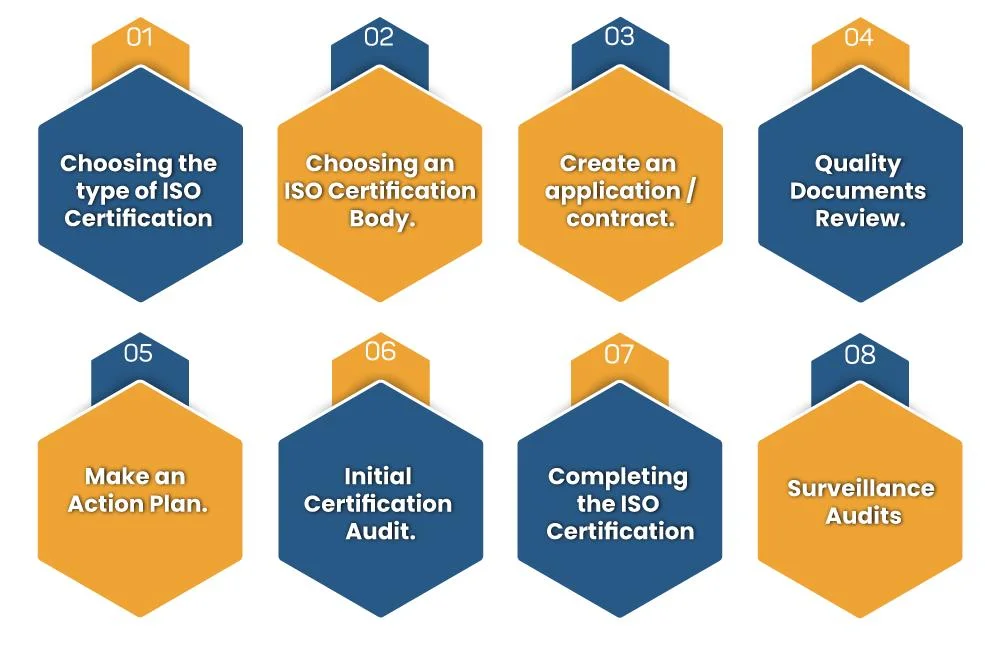
Implementing an ISO 9001 system follows a structured and systematic approach designed to ensure compliance, efficiency, and continuous improvement. Below is a simplified step-by-step process:
Key Steps in ISO Implementation:
- Gap Analysis – Identify gaps between current processes and ISO requirements
- Planning – Define scope, objectives, and quality policies
- Documentation – Develop procedures, manuals, and records
- Training & Awareness – Educate employees on ISO standards
- Implementation – Apply processes across the organization
- Internal Audit – Evaluate system performance and compliance
- Management Review – Assess effectiveness and improvement areas
- Certification Audit – External audit for ISO certification
Real-World Examples of QMS Implementation
These real-world case studies demonstrate how businesses of all sizes successfully implemented an ISO 9001 system to achieve certification, improve efficiency, and drive sustainable growth.
1. Mackubin Group ISO 9001 Case Study: Small Firm Achieves Certification Without Disruption
Company Background
Mackubin Group, Inc. is a small distribution company based in New Brighton, Minnesota. The company provides high-quality automation components to the aerospace and defense industry. Despite having only four employees, the company maintains strong customer relationships.
The Challenge
The company required ISO 9001:2015 certification to meet key customer demands and become eligible to receive government contracts.
They lacked an established Quality Management System (QMS), a qualified quality manager, and a limited budget that did not allow for hiring consultants. Moreover, the system needed to be implemented without interfering with day-to-day operations.
The Solution & Implementation
Mackubin Group used an approach supported by a structured ISO toolkit designed for service providers. Starting in November 2024, the team followed a step-by-step process, completed the necessary training, and defined their QMS. Gap analysis and weekly meetings were used to refine the processes, such as communication with customers. The team managed to adjust quickly and remain on time even after their internal auditor left halfway through the project.
Certification Success
In April 2025, the company underwent a two-day audit. They attained certification in the first attempt with zero nonconformities, and the whole process took five months.
Key Results & Impact
The certification allowed Mackubin Group to secure government contracts and explore production-level opportunities. It also simplified processes, enhanced process uniformity, and incorporated quality into day-to-day operations, which demonstrated that even small companies can achieve ISO success effectively.
Benefits of ISO 9001 certification.

2. SemiLink ISO 9001 Case Study: Building a Startup on Quality Foundations
Company Background
SemiLink Materials was established in 2023 in Montana. It had only one immediate objective: to become an ISO 9001-certified semiconductor supplier or lose potential clients. The company distributes high-purity materials, where strict quality standards are essential.
The Challenge
For SemiLink, ISO 9001 was not optional but a critical market entry requirement. With no existing processes, the startup had to build a complete Quality Management System (QMS) from scratch while launching operations. They also needed to prove compliance without historical data, making certification even more complex.
The Solution & Implementation
SemiLink chose a full-service consultancy approach to ensure fast and accurate certification. Working closely with an experienced consultant, the company designed a QMS aligned with its long-term business vision. The process involved company-wide participation, regular planning sessions, and integration of ISO requirements into developing operations. Instead of treating ISO 9001 as a separate task, the team embedded it directly into their business model.
Certification Success
Within six months, SemiLink achieved certification through a two-stage audit. The result was exceptional, reflecting a highly effective system built from the ground up.
Key Results & Impact
Certification enabled immediate market access and the first sales. More importantly, ISO 9001 became the foundation of SemiLink’s operations, ensuring consistency, efficiency, and scalability. This case highlights how startups can use ISO standards not just for compliance, but as a powerful framework for long-term growth.
Want to achieve similar results in your business? Partner with Qualitas Consulting to implement ISO the right way.
3. Kingpin Dynamics ISO 9001 Case Study: One-Person Firm Achieves Certification
Company Background
Kingpin Dynamics is a one-person engineering consultancy based in Trollhättan, Sweden, led by Tayfun Hekimoglu. The company specializes in automotive chassis systems, product development, and process engineering.
The Challenge
As a solo entrepreneur, Tayfun faced unique constraints. He needed to implement a credible ISO 9001 Quality Management System (QMS) to enhance market credibility and secure larger contracts. However, with no staff, no prior system, and ongoing client commitments, the implementation had to be completed without disrupting daily operations.
The Solution & Implementation
Tayfun adopted ISO 9001 standards using a structured implementation approach. He began by completing structured training, including leadership, implementation, and auditing. Using templates and a step-by-step framework, he developed the QMS independently while continuing client work. His disciplined, systems-based approach enabled full implementation in just one month. Many organizations report efficiency improvements of up to 20–30% after ISO 9001 implementation.
Certification Success
Kingpin Dynamics underwent the certification audit. The company achieved certification on the first attempt, with only one minor nonconformity related to internal auditing, an expected challenge for a one-person firm.
Key Results & Impact
The certification significantly improved credibility and marketability. More importantly, it enhanced internal workflows, reduced inefficiencies, and introduced a strong quality-focused mindset. The QMS now serves as a scalable foundation, positioning Kingpin Dynamics for future growth and expansion.
4. AirportCreators ISO 9001 Case Study: From Partner Dependency to Global Project Success
Company Background
AirportCreators is a Netherlands-based engineering and airport development consultancy located at Schiphol Airport. The firm specializes in future-focused airport projects, including strategic planning, terminal development, and innovative ventures like the Hyperloop.
The Challenge
AirportCreators faced a major growth barrier: without ISO certification, they could not independently bid for global tenders. Relying on certified partners proved risky, as missed deadlines impacted their reputation. Internally, they also wanted to improve efficiency, communication, and move toward a paperless system.
The Solution
To overcome these challenges, the company adopted a structured ISO 9001 implementation approach. Their goal was not just certification, but full team involvement to ensure long-term adoption and ownership of the Quality Management System (QMS).
Implementation Process
The project began with a collaborative approach. Each team member was assigned responsibility for specific ISO clauses, using templates to build processes. Regular team reviews ensured alignment and integration across departments. Over five months, the company developed and refined a practical, process-based QMS tailored to its operations.
Certification and Results
Following real-world testing, AirportCreators underwent a two-day audit and achieved ISO 9001 certification with zero nonconformities. The results were immediate:
- Ability to bid independently on international projects
- Improved internal communication and document control
- Increased operational efficiency and quality awareness
Key Takeaway
AirportCreators transformed ISO 9001 from a compliance requirement into a strategic asset, enabling growth, independence, and long-term operational excellence.
5. Pace Engineering ISO 9001 Case Study: Streamlining Heavy Engineering Operations
Company Background
Pace Engineering, established in 1992 in New Plymouth, New Zealand, specializes in heavy machining, transport engineering, and infrastructure projects. With decades of expertise, maintaining precision and quality has always been central to its operations.
The Challenge
The company faced a critical transition when its legacy Q-Base system was phased out. Moving to ISO 9001:2015 required not only system upgrades but also a cultural shift. With just a two-person implementation team and ongoing high-stakes projects, they needed to avoid disruptions, especially during the COVID-19 pandemic.
The Solution
Pace Engineering adopted an ISO 9001 approach using a structured implementation framework. This allowed them to align their existing practical workflows with ISO standards without adding unnecessary complexity or relying on external consultants.
Implementation Process
Starting in early 2020, the team translated familiar Q-Base processes into ISO-compliant systems using templates and guided tools. Initial resistance from staff was addressed through training and real-world application. The flexible, digital toolkit also enabled progress despite pandemic-related challenges.
Certification and Results
Within nine months, Pace Engineering successfully achieved ISO 9001 certification. The audit identified only two minor nonconformities, reflecting a strong and well-adapted system.
Key outcomes included:
- Streamlined production and administrative processes
- Improved efficiency and reduced operational friction
- Stronger risk management and continuous improvement culture
- Enhanced credibility in the engineering market
Key Takeaway
Pace Engineering turned a mandatory transition into a strategic advantage, proving that even small teams can successfully implement ISO 9001 while improving performance and resilience.
6. J.T. Fennell ISO 9001 Case Study: Unifying Operations and Driving Growth
Company Background
J.T. Fennell is a family-owned, third-generation steel fabrication firm in Illinois, USA. The company focuses on custom steel components and has over 100 employees and two locations, Chillicothe and Peoria. It has gained a good reputation in terms of quality and reliability since 1975.
The Challenge
Clients were also demanding certification to issue large contracts. The operation at two locations established an inconsistency in processes and compartmentalization. J.T. Fennell required a single Quality Management System (QMS) as well as securing the support of the staff at both plants.
The Solution
The company implemented a self-managed ISO 9001 strategy using a structured internal framework. It aimed to develop an in-house system that would enable ownership and sustainability.
Implementation Process
The project was led by a cross-functional team of seven people headed by senior management. Their training and step-by-step instructions enabled them to establish a QMS in just three months. The system standardized major processes in both plants but retained site-specific requirements. A culture of quality was instilled through early internal audits and involvement of the teams.
Certification and Results
In 2020, J.T. Fennell achieved certification on the first attempt after a five-day audit covering both facilities.
Key results included:
- Significant sales growth and access to new contracts
- Improved production efficiency and reduced delivery times
- Stronger process consistency across both sites
- Enhanced employee engagement and quality culture
Key Takeaway
By implementing ISO 9001 in-house, J.T. Fennell not only achieved certification but also strengthened operations and unlocked new business opportunities.

Key Outcomes Across All Case Studies
- Shorter ISO certification periods.
- Increased operational efficiency.
- Enhanced compliance and audit preparedness.
- More access to contracts and market opportunities.
- Improved customer satisfaction and process consistency.
Final Thoughts
These case studies indicate that an ISO Quality Management System is not restricted to large enterprises. Startups and established organizations in all industries achieve measurable gains in effectiveness, compliance, and expansion. Applied appropriately, ISO 9001 is not just a certification; it is a strategic long-term asset.
When implemented correctly, ISO 9001 becomes more than a certification; it becomes a long-term strategic advantage that drives consistency and growth.
In our experience, businesses that integrate ISO systems into daily operations achieve faster certification and long-term efficiency gains.
This article is prepared by ISO specialists at Qualitas Consulting, with experience in QMS implementation across multiple industries.
How to prepare for ISO certification? Read the complete guide.