
What Does an Audit Do? An audit checks whether your business follows the required procedures, meets relevant standards, and manages risks effectively. In Qatar, an ISO audit helps identify compliance gaps, improve business processes, and prepare your company for certification.
Understanding what an audit does can help you strengthen your management system and meet applicable ISO requirements. Qualitas Consulting can help your business prepare for ISO audits and work towards compliance. Explore Qualitas Consulting’s services.
What Does an Audit Do for Businesses in Qatar?
A business audit gives you a better picture of how your processes are working. It compares actual activities to internal procedures, customer expectations and applicable requirements. The auditors then identify risks, weaknesses and opportunities for improved performance.
For example, a company pursuing ISO 9001 may need to review customer complaints, supplier performance, product inspections, and quality records. An audit of the quality management system determines whether these activities support reliable products and services. It can also detect ambiguous responsibilities, repetitive mistakes, or training deficiencies in employees.
Audits can support businesses across Qatar’s competitive commercial environment. Qatar National Vision 2030 identifies four pillars: human, social, economic, and environmental development. Effective management systems can enable responsible business practices but certification alone does not mean commercial success or legal compliance.
The common objectives of the audit are:
- Verifying compliance with standards and procedures.
- Pinpointing operational risks and recurrent issues.
- Measuring the effectiveness of the process and staff awareness.
- More effective use of resources and business performance.
- Providing information for management decisions.
The key is to utilize the findings of the audit to make practical improvements rather than to treat the report as a formality.
Identify Your Compliance Gaps.
What Do Auditors Check During an ISO Audit?
Auditors examine evidence to determine whether your business meets the requirements of its chosen standard. They compare documented policies with actual working practices instead of relying on paperwork alone.
The checks depend on your industry, audit scope, and management system. For example, ISO 9001 focuses on quality management, while environmental and information security standards address different concerns. The International Organization for Standardization (ISO) explains the requirements of its quality management standard.
During an audit, assessors may examine:
- Policies and procedures: Are responsibilities clear, and do employees follow approved processes?
- Records and documentation: Can you provide training records, inspection results, and customer feedback?
- Risk controls: Does your company identify risks and manage them appropriately?
- Employee awareness: Do staff understand their duties and reporting responsibilities?
- Performance monitoring: Do results show that processes meet planned requirements?
- Customer satisfaction: How does your business handle complaints and service failures?
An ISO audit checklist helps your team organise these records and identify missing evidence. However, no single checklist covers every standard or business situation.
Auditors record nonconformities when evidence shows that a requirement hasn’t been met. Your team must investigate the underlying cause and select suitable corrective actions. Addressing the cause helps prevent the same problem from returning.

What Are the Main Stages of an ISO Audit?
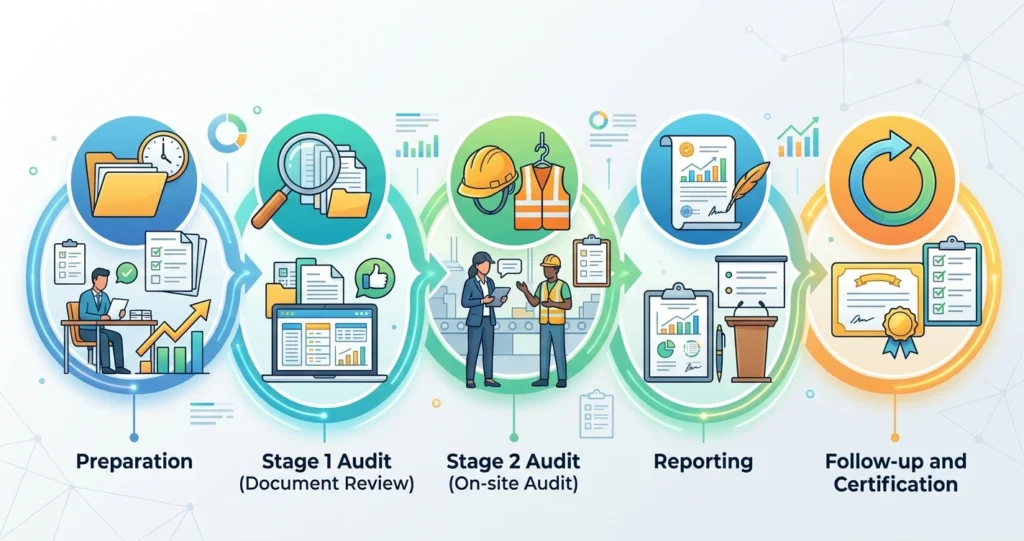
The ISO audit process moves from planning to evidence collection, reporting, and follow-up. Understanding each stage helps your employees prepare without disrupting routine operations.
1. Audit planning and preparation
The auditor establishes the objectives, scope, criteria, schedule, and resources. Your team identifies the departments, locations, and processes included in the assessment. A risk assessment can also help prioritise activities that require closer attention.
2. Document review and evidence gathering
Auditors review policies, procedures, records, and other documented information. During an on-site assessment, they may interview employees, observe activities, and examine samples of completed work. These checks establish whether documented procedures reflect actual operations.
3. Findings and corrective actions
The auditor compares the evidence with the agreed criteria and records the results. If a nonconformity arises, your business investigates its cause and develops a corrective action plan. The auditor may later verify whether the response has resolved the issue effectively.
4. Reporting and follow-up
The auditor prepares a report describing the scope, findings, and conclusions. Management can use it to assign responsibilities, set deadlines, and monitor progress. Internal audit managers may review or approve reports according to company procedures.
Different audits serve different purposes:
| Audit type | Main purpose |
| Internal ISO audit | Evaluates the management system and identifies areas for improvement. |
| Supplier or customer audit | Checks whether a supplier meets agreed requirements. |
| External certification audit | Assesses conformity through an independent certification body. |
Initial ISO certification assessments commonly involve two stages. Stage 1 reviews the management system’s readiness and relevant documentation. Stage 2 examines whether the system operates effectively in practice. The certification body decides whether the applicable certification requirements have been met.
ISO 19011 guides auditing management systems. It helps organisations understand sound audit practices but does not itself grant certification.
How Can Qatar Businesses Benefit from ISO Audit Preparation?
Preparation gives your team time to address weaknesses before an external assessment. It also improves accountability, reduces confusion, and helps managers understand where resources are needed.
A practical ISO audit preparation plan can help your business:
- Reduce recurring errors and improve service consistency.
- Strengthen supplier controls and complaint handling.
- Identify training needs and clarify employee responsibilities.
- Address compliance gaps before certification assessments.
- Track improvements through regular management reviews.
Research supports the value of implementing management systems properly. An ISO research summary examining 42 empirical studies reported potential financial benefits from ISO 9001 implementation, particularly when organisations focused on internal improvements rather than certification alone.
Another study examined 200 aerospace and transportation companies and highlighted the role of internal auditing and corrective actions in customer satisfaction. Although these findings don’t guarantee similar results in every sector, they show why businesses should treat audits as improvement tools.
Before an assessment, assign responsibility for each process, check that records are current, and review previous findings. Management should then monitor corrective actions to confirm that they deliver lasting results.
Remember that ISO certification doesn’t automatically satisfy every legal obligation in Qatar. Your company must identify and meet the regulatory requirements that apply to its industry and activities.
How Qualitas Consulting Supports ISO Compliance in Qatar
Preparing for an audit becomes easier when you understand the standard and know which gaps need attention. Qualitas Consulting can help businesses in Qatar explore suitable ISO consulting and audit preparation support.
Depending on your requirements, relevant services may include gap analysis, internal auditing, management system implementation, and pre-assessment preparation. These activities help you organise documentation, understand applicable requirements, and address weaknesses before approaching a certification body.
Costs vary according to the chosen standard, company size, number of locations, process complexity, and level of support required. Consulting fees and certification body fees are often separate. There is no reliable universal price for an ISO audit in Qatar, so request a tailored quotation based on your business needs.
When choosing a consultant, ask about relevant industry knowledge, project deliverables, timelines, and ongoing support. Also, confirm that your certification body operates independently of the consulting arrangement.
Visit Qualitas Consulting to discuss your requirements and explore support for your ISO objectives.
Conclusion
Understanding “what does an audit do” helps you identify weaknesses, improve processes, and demonstrate that your management system meets relevant requirements. For businesses in Qatar, regular audits can support stronger operations and better preparation for ISO certification.
Start by reviewing your procedures, organising records, and addressing known gaps. With a clear plan and suitable professional guidance, you can turn audit findings into practical improvements that support long-term business performance.
FAQs
What happens during an ISO audit?
Auditors review documents, interview employees, observe processes, and check records against the relevant ISO standard. They report findings, including any nonconformities, and may require corrective actions.
What is the definition of an audit according to ISO standards?
An audit is a systematic, independent, and documented process for collecting and objectively evaluating evidence to determine whether specified requirements are met.
What is an ISO audit checklist?
An ISO audit checklist is a practical list of questions, requirements, and evidence to review during an audit. It helps auditors assess compliance consistently, but it should be tailored to the relevant ISO standard and business processes.
What is an ISO compliance audit?
An ISO compliance audit evaluates whether an organisation’s management system, processes, and records meet the requirements of a specific ISO standard. It may be conducted internally or by an independent certification body.
Can you fail an ISO audit?
Yes. An organisation may not achieve certification if the audit identifies significant nonconformities that remain unresolved. The certification body evaluates the findings and determines whether certification requirements have been met.