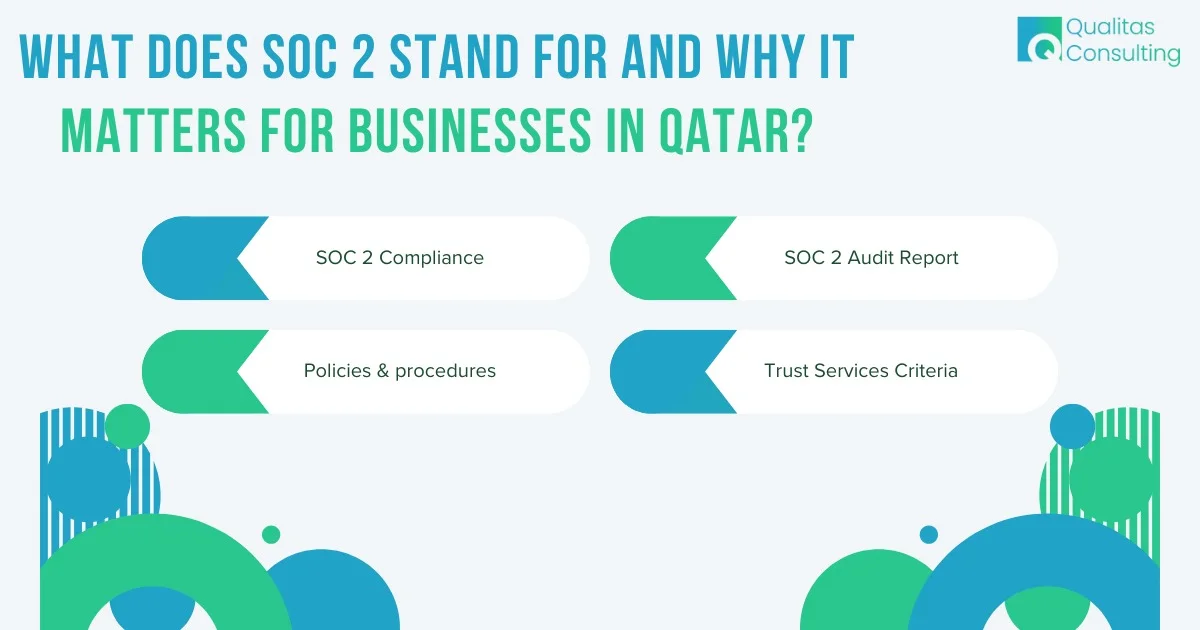
With cyber threats on the rise and data becoming the world’s most valuable asset, understanding “what does SOC 2 stand for” is becoming essential for businesses in Qatar. SOC 2 stands for System and Organization Controls 2. It shows how well an organisation protects customer data. This is done through strong internal controls, adherence to the Trust Services Criteria, and ongoing monitoring.
A 2024 IBM Security report revealed that the average cost of a data breach has reached USD 4.88 million globally, showing just how vital structured compliance systems have become.
For companies in Qatar’s growing cloud and fintech sectors, SOC 2 compliance offers a strong competitive advantage. This boosts client trust and enhances international credibility. SOC 2 certification helps avoid expensive breaches. It also ensures your business fits with the nation’s goal for a secure, knowledge-driven economy.
Partnering with Qualitas Consulting Qatar gives you local insights and global expertise. We help you complete the SOC 2 certification process efficiently. Your organization stays secure, trusted, and ready for global opportunities.
What Does SOC 2 Stand For?
SOC 2 stands for “Systems and Organisation Controls 2” (or “System and Organization Controls 2”). It’s a formal standard created by the American Institute of Certified Public Accountants for service organisations.
SOC 2 allows third-party auditors to check whether a company has the right controls for data security. This is based on specific trust principles. The goal? To assure stakeholders that systems managing their data are well-governed, secure, and dependable.
The standard emerged because traditional frameworks like financial reporting audits weren’t enough to evaluate the risks of cloud services, SaaS, and outsourced infrastructure. SOC 2 fills that gap, offering a means to assess how providers manage data across processes, controls, technology, and human factors.
For businesses in Qatar aiming for strong cloud data security compliance, knowing exactly what SOC 2 stands for is the first step in building a trustworthy reputation.
What is SOC 2 Compliance?
So you know what SOC 2 stands for, now what does it mean to be SOC 2 compliant? To achieve SOC 2 compliance, your organisation must adopt and document controls. An independent auditor will then confirm that these controls meet one or more Trust Services Criteria.
Who needs it?
A SOC 2 report is essential for any service organization that handles sensitive customer data. This is particularly true for companies offering cloud-based services or Software-as-a-Service (SaaS). In Qatar, organizations that typically need a SOC 2 report include fintech platforms, telecom services, healthcare data systems, managed IT services, and providers of other outsourced solutions.
How does it work?
- Your organisation uses a security framework for service providers. It aligns with the SOC 2 Trust Services Criteria.
- You engage a qualified SOC 2 auditor, typically a CPA firm recognised for such attestations.
- The auditor reviews your controls (design and/or operating effectiveness depending on the report type).
- You receive an SOC 2 audit report that provides assurance to clients, partners, and regulators.
Note: Being compliant doesn’t mean you’ve “passed” a test forever; it means you’re set up to continuously meet the controls defined for your scope. Keeping that up is key in an evolving environment of IT compliance frameworks and third-party risk.
Ready to make your organization SOC 2 compliant?
Why SOC 2 Matters for Businesses in Qatar?
Qatar’s national agenda emphasizes smart services, data innovation, and global connectivity. Within that context, why SOC 2 is important becomes clear.
Key drivers in Qatar
- Trust and market access: Global clients often require vendors to present independent assurance, such as a SOC 2 report; without it, you may lose contract opportunities.
- Data protection expectations: As local regulations evolve, organizations are under increasing pressure to display strong governance for customer data protection, not just locally but globally.
- Competitive differentiation: For Qatari organisations offering services internationally, a SOC 2 certification process signals you are serious about risk management and readiness.
- Preventing data breaches: With rising cyber threats, a robust environment aligned with the AICPA security standards helps you mitigate risks and show proof of control to stakeholders.
In short, for businesses in Qatar, obtaining a SOC 2 attestation isn’t just a compliance tick-box; it’s an enabler for growth, resilience and credibility.
SOC 2 Trust Principles Explained
One of the distinctive features of SOC 2 is its use of the Trust Services Criteria (TSC), five key pillars that define what matters when evaluating a service organization’s control environment.
| Principle | What it checks | Why it matters |
| Security | Protection of system resources and data from unauthorised access or modification. | This one is mandatory in every report; foundational to everything else. |
| Availability | Systems being operational, accessible, and usable as committed. | For service providers, downtime risks losing contracts and trust. |
| Processing Integrity | System processing is complete, valid, accurate, timely and authorised. | Ensures data and transactions are handled right — not just stored. |
| Confidentiality | Information designated as confidential is protected. | You might hold trade secrets or sensitive client details — they must stay safe. |
| Privacy | Personal information is collected, used, retained, disclosed, and destroyed in conformity with framework and relevant laws. | In Qatar’s context, and globally, personal data regulation is growing ever stronger. |
Although all five matter, the Security criterion is always in scope. Organizations choose from the others based on their business model, customer needs, or regulatory pressure. Understanding the Trust Services Criteria for SOC 2 is essential if you’re mapping your control programme or planning an audit.
SOC 2 Type I vs Type II: What’s the Difference?
If you’ve reached the stage of considering an audit, you’ll encounter the distinction between SOC 2 Type I and Type II. Understanding the difference helps you decide your strategy.
| Report Type | Focus | Time Period | Typical When |
| Type I | Evaluates the design of controls at a specific point in time. | Single point (e.g., 30 June 2025) | Organisations seeking to demonstrate readiness quickly. |
| Type II | Evaluates both design and operating effectiveness of controls over a period (commonly 6–12 months). | Time-span (3–12 months) | Organisations seeking robust assurance for clients and growth. |
If you wonder about the difference between SOC 2 Type I and Type II, think of Type I as a snapshot; Type II as a video of consistent performance. Many Qatari companies now aim straight for Type II because customers increasingly expect that level of assurance. Choosing the right type at the outset saves time, money, and reputational risk down the road.
Not sure which SOC 2 report fits your business?
The SOC 2 Audit Process: How It Works?
When you understand what SOC 2 stands for and why it matters, the next logical question is: what is a SOC 2 audit, and how does the SOC 2 audit process unfold?
Key Stages of the Audit Process:
- Readiness Assessment
- Conducted internally or with a consultant to identify gaps relative to the SOC 2 controls list and SOC 2 compliance checklist.
- Helps in audit readiness for SOC 2 and reduces surprises during the formal audit.
- Control Implementation and Documentation
- Establish policies such as access control, incident response, encryption, and monitoring.
- Document your system description (scope, boundaries, sub-service organizations).
- External Audit Engagement
- Engage an accredited SOC 2 auditor, usually through a CPA firm.
- For a Type II audit, the auditor collects evidence during the period. They evaluate controls and test how well they operate.
- Report Issuance
- The auditor issues the independent audit report. This report includes the opinion, a description of the system, findings, and recommendations.
- You receive either unqualified (clean) or qualified (exception) opinions.
- Continuous Monitoring and Recertification
- While no certificate technically “expires,” customers expect annual updates.
- Ongoing maintenance ensures you stay aligned with evolving threats and requirements.
Timeline & Cost (typical for a small to mid SaaS organization):
- Ready state: 3–6 months
- Type I audit: 1–2 months
- Type II audit: 6–12 months (including period)
- Cost: USD 12k–20k+ depending on scope and complexity. Knowing the audit process helps you allocate resources and set realistic goals for your business in Qatar.
Key SOC 2 Compliance Requirements
SOC 2 compliance makes sense when you break it down: the policies, controls, and documents required.
Core Elements:
- Policies and procedures: Information security policy, privacy policy, access control procedures, and change management.
- Technical Controls:
- Encryption for data at rest and in transit
- Firewall and intrusion detection
- Identity and access management (IAM)
- Logging and monitoring
- Operational controls: Incident response, vendor management, business continuity, training programmes.
- Documentation: System description of boundaries, description of processes, and evidence of control operations.
- Continuous auditing and monitoring: You need to prove that controls are not just designed, but also effective for Type II reports.
Compliance Checklist (Simplified):
- Have you defined the scope (systems, data, boundaries)?
- Did you document policies aligned with the Trust Services Criteria?
- Are technical controls implemented and tested?
- Is there evidence that controls are operating over time?
- Have you engaged a credible auditor?
- Have you reviewed and acted on any audit exceptions?
Meeting the SOC 2 compliance requirements is a journey, not a one-time task. For Qatari companies expanding regionally, it shows you meet global standards, not just local ones.
The Benefits of SOC 2 Certification for Qatari Organizations
One major reason to ask “what does SOC 2 stand for?” is the value it adds once in place. Let’s explore the benefits:
Benefits Overview:
- Boosted trust and reputation: A formal SOC 2 certification shows clients that you value information security management.
- Global recognition: Having a SOC 2 report helps unlock international markets and partnerships, especially where cloud data security compliance is customer-mandated.
- Risk Reduction: Uses a structured system to protect against data breaches. This helps prevent breaches and shield the reputation.
- Competitive advantage: When your peers in Qatar and beyond don’t have SOC 2, you stand out.
- Operational improvement: Preparing for SOC 2 improves your internal processes and control environment. This also aligns with wider IT compliance frameworks.
Real-World Impact in a Table:
| Benefit | Impact for Qatari Business |
| Trust with clients | Helps local firms win contracts with global organisations demanding SOC 2 attestation. |
| Regulatory alignment | Improves alignment with local and regional data protection laws, reducing legal exposure. |
| Market access | Opens doors to international cloud and SaaS markets where compliance is a prerequisite. |
| Efficiency | Streamlining controls often reduces downtime and improves service reliability. |
| Long-term growth | A mature control environment supports scaling and resilience. |
The benefits of a strong SOC 2 certification process are clear. Qatar-based organisations can lead the region in secure digital services.
Why Choose Qualitas Consulting Qatar for SOC 2 Certification?
You now know what the term stands for, why it matters, and how the process plays out. But who should guide you through it? That’s where Qualitas Consulting Qatar comes in.
Local expertise, global standards
- Qualitas has a strong grasp of Qatar’s business landscape and culture. It also excels in international standards such as SOC 2 and ISO 27001.
- They help you navigate not just the audit, but also the planning, control implementation, documentation, and continuous improvement.
- Their qualified team supports your entire journey: from audit readiness for SOC 2 to post-audit monitoring.
Tailored service for local companies
- Whether you’re a startup in Doha, an established fintech, or a regional cloud provider, Qualitas adapts its approach to your size and scope.
- They offer direct help with writing your system description, aligning your service organization’s controls, and working with auditors.
Proven track record
- Qualitas has helped many Qatari organizations strengthen their security, meet cybersecurity compliance standards, and provide credible assurance with their SOC 2 audit report.
- Their focus on practical, scalable solutions means you won’t waste resources; you’ll gain lasting benefit.
Conclusion
SOC 2 compliance isn’t just a certification. It’s a promise of trust, accountability, and top-notch data protection. For companies in Qatar, understanding what does SOC 2 stand for and why it matters for businesses in Qatar means recognizing how vital secure operations are in today’s digital economy. As cyber risks increase and global clients seek better assurance, SOC 2 certification shows your organisation meets top security and privacy standards.
With Qualitas Consulting Qatar, achieving this milestone becomes simple and effective, from audit readiness for SOC 2 to certification success. Aligning with AICPA security standards helps Qatari businesses boost credibility. It also prevents data breaches and builds long-term client trust in every transaction.
FAQs
What does SOC 3 stand for?
SOC 3 means System and Organization Controls 3. It includes the same Trust Services Criteria as SOC 2. It offers a public summary report that simplifies information. This report lacks detailed audit findings, making it ideal for marketing or general sharing.
What is meant by SOC 2?
SOC 2 means System and Organization Controls 2. It’s a framework created by the AICPA. It helps evaluate how service organisations handle customer data. This is based on five Trust Services Criteria:
Security
Availability
Processing integrity
Confidentiality
Privacy
What is the difference between SOC 1 and SOC 2?
SOC 1 focuses on financial reporting controls, while SOC 2 evaluates data security and privacy controls. SOC 1 is mainly for firms that affect clients’ financial statements. SOC 2 is for those managing sensitive customer data.
What is the difference between ISO 27001 and SOC 2 mapping?
ISO 27001 is an international information security management standard, while SOC 2 is a U.S. auditing framework. SOC 2 mapping to ISO 27001 shows where controls overlap. ISO 27001 explains how to manage security. SOC 2 checks how well those controls work.