
A workplace accident can disrupt a business in seconds. The International Labour Organization estimates that 2.93 million workers die annually from work-related diseases and accidents worldwide. For organizations in Qatar, ISO Safety Standards provide a structured way to identify hazards, control risks, involve workers, and strengthen workplace safety.
ISO 45001:2018 offers an internationally recognized framework for occupational health and safety management. This guide covers its key requirements, Qatar-specific considerations, certification process, documentation, costs, and benefits.
Qualitas Consulting supports organizations across Qatar with ISO 45001 implementation, gap analysis, internal audits, training, and certification support, backed by expertise across 150+ ISO standards.
What Are ISO Safety Standards in Qatar?
Understanding workplace safety starts with choosing standards that help organizations control hazards and protect workers.
Understanding Workplace Safety Standards
Workplace safety standards help organizations identify hazards, manage risks, protect employees, and improve safety performance. In Qatar, businesses must also follow national legal requirements. The Qatar Labour Law requires employers to inform workers about occupational risks and take appropriate precautions against workplace injuries, diseases, machinery hazards, and fires.
In Great Britain, fatal workplace injuries to employees have fallen by roughly 85% since HSE’s founding legislation was passed 50 years ago, showing what sustained, systematic safety regulation can achieve over time.
ISO 45001 strengthens these efforts by connecting leadership, risk assessment, worker participation, operational controls, audits, and continual improvement within one management system.
ISO 45001:2018 and Occupational Health & Safety
ISO 45001:2018 is an international occupational health and safety standard designed to help organizations manage OH&S risks systematically. It applies to businesses of different sizes and across various industries.
Its framework covers OH&S policy, objectives, hazard identification, legal requirements, emergency preparedness, incident investigation, internal audits, management review, and continual improvement.
Why ISO 45001:2018 Matters in Qatar
Qatar’s rapidly developing industries make systematic occupational safety more important than ever for employers and workers.
Qatar Workplace Safety Requirements
In Qatar, a legal regime governs companies, imposing clear duties on employers to protect workers. The Labor Law requires the employer to inform workers of the risks and measures of prevention in the workplace and to take reasonable precautions against occupational injury and illness.
An ISO 45001 system organizes those responsibilities with documented processes, assigned responsibilities, risk controls, compliance evaluation, and performance monitoring. It does not supersede Qatari law. Instead, it provides organizations with a structured framework for addressing applicable legal and other requirements.
Under the ILO–Qatar technical cooperation programme, the incidence of occupational injuries fell by approximately 37%, from 54 to 34 per 100,000 workers between 2008 and 2016, even as Qatar’s workforce grew by nearly 80%.
Worker Health and Safety
Strong safety performance starts before an incident occurs. ISO 45001 emphasizes worker participation, consultation, hazard reporting, risk assessment, and preventive controls.
That approach is applicable in workplaces where conditions can change rapidly. Employees often know about practical hazards which management might miss. Thus, giving workers meaningful opportunities to raise concerns can improve the management of health and safety at work, while strengthening the overall safety culture.
Contractor and Supply Chain Expectations
Many large projects rely heavily on contractors, subcontractors, suppliers and temporary workers. In addition, their activities can introduce other hazards that could affect the employees and operations of an organization.
A structured OH&S management system helps organizations to define what they require from contractors, to evaluate the risks that are important, to inform contractors of what they need to do to manage those risks and to monitor performance. For Qatari companies competing for large contracts, credible worker welfare standards in Qatar can also increase confidence among clients and project partners.
Key ISO 45001:2018 Requirements
Behind effective safety performance lies a structured framework that turns hazard awareness into measurable workplace controls.
Organizational Context and Leadership
ISO 45001 begins with understanding the organization’s context, interested parties, OH&S risks, and management-system boundaries. Leadership then establishes direction through an OH&S policy, responsibilities, resources, and accountability.
Senior management cannot simply delegate safety to one department. Effective implementation requires visible leadership and integration of safety objectives into everyday business decisions.
Worker Consultation and Participation
Worker consultation and participation form a distinctive part of ISO 45001. Employees should have suitable opportunities to contribute to hazard identification, investigations, planning, and safety improvements.
A Gallup study found that workplaces with actively engaged employees experience up to 63% fewer safety incidents than disengaged workplaces.
For practical implementation, organizations should define communication channels, consultation methods, reporting arrangements, and mechanisms for removing barriers to participation.
Hazard Identification and Risk Assessment
Effective workplace hazard identification asks what could cause injury or ill health before controls fail. Organizations should consider routine and non-routine activities, equipment, contractors, visitors, workplace conditions, and changes.
A documented risk assessment then helps determine appropriate controls. ISO 45001 supports risk-based thinking while encouraging organizations to consider opportunities for improving OH&S performance.
Operational Safety Controls
Identifying a hazard is only the beginning. Organizations need effective operational controls that prevent or reduce exposure.
The hierarchy of controls provides a useful approach:
- Eliminate the hazard where practical.
- Substitute the hazardous process or material.
- Apply engineering controls.
- Establish administrative controls.
- Use personal protective equipment where necessary.
It is often best to control the source of the hazard rather than depending only upon the actions of workers.
Emergency Preparedness and Response
Emergencies can include fires, chemical releases, equipment failures, medical events, severe weather, or other foreseeable scenarios. ISO 45001 requires organizations to establish processes for emergency preparedness and response.
Plans should define responsibilities, communication methods, response procedures, training, testing, and post-event evaluation. Drills also provide valuable evidence about whether emergency arrangements work under realistic conditions.
Performance Evaluation and Improvement
A working system needs empirical evidence. Organizations should establish appropriate indicators for monitoring and measurement, assess compliance, perform internal audits, and carry out management reviews.
Then incident investigation and corrective action attempt to address root causes, not just symptoms that are visible. Over time, OH&S performance should be progressively improved in normal business management.
Who Needs ISO 45001:2018 in Qatar?
Any company may find a more efficient safety structure to be helpful, but certain industries in Qatar are particularly vulnerable.
Construction and Infrastructure
Construction companies face changing worksites, heavy equipment, working-at-height hazards, temporary structures, subcontractors, and multiple simultaneous activities. ISO 45001 for construction companies in Qatar can provide a consistent framework for managing those risks.
Oil and Gas
Oil and gas operations involve significant process, chemical, mechanical, fire, and emergency-response risks. A structured management system supports stronger occupational risk management across employees, contractors, and operational activities.
Manufacturing and Industrial Businesses
Manufacturing environments can involve machinery, chemicals, electrical systems, material handling, noise, and repetitive tasks. ISO 45001 for manufacturing companies helps organizations connect hazard controls with operational processes.
Healthcare and Other High-Risk Sectors
Healthcare, logistics, transport, facilities management, hospitality, and other sectors can also benefit. ISO 45001 applies broadly rather than only to traditionally high-risk industries.
Benefits of ISO 45001:2018 Certification
A well-implemented safety management system can deliver benefits that extend far beyond simply meeting certification requirements.
Safer Workplaces
A structured system helps organizations identify hazards earlier and strengthen preventive controls. This supports workplace injury prevention and more consistent safety practices.
Regulatory Compliance
ISO 45001 requires organizations to identify and evaluate applicable legal and other requirements. Consequently, it can strengthen legal compliance processes alongside existing Qatar obligations.
Fewer Workplace Incidents
Better hazard controls, worker participation, emergency planning, and incident investigation can help reduce exposure to occupational risks. ISO itself identifies reduced workplace incidents and injuries among the framework’s potential benefits.
Stronger Business Reputation
Certification can demonstrate a systematic commitment to employee safety and responsible management. That signal may matter when customers, partners, employees, or project owners assess suppliers.
Better Tender Opportunities
Some customers and procurement processes expect suppliers to demonstrate mature management systems. Certification doesn’t guarantee contract awards. However, it can support credibility where safety management forms part of supplier evaluation.
Turn safety into a business advantage.
How to Get ISO 45001:2018 Certification in Qatar
Getting certified becomes easier when you follow a clear sequence from identifying gaps to demonstrating effective implementation.
Conduct a Gap Analysis
Start by comparing current practices against the ISO 45001 requirements in Qatar and your applicable legal obligations. The gap analysis identifies missing processes, weak controls, documentation issues, and implementation priorities.
Develop and Implement the OH&S System
Next, establish the required framework, including policy, objectives, risk processes, responsibilities, operational controls, emergency arrangements, and documented information. Implementation should reflect actual workplace conditions rather than create paperwork without practical value.
Perform Internal Audits
An internal OH&S audit tests whether processes are implemented and effective. Auditors should examine records, interview workers, observe operations, and identify opportunities for corrective action.
Complete Management Review
Management review evaluates whether the system remains suitable and effective. Inputs can include audit results, incidents, compliance evaluation, objectives, worker feedback, and performance trends.
Pass the Certification Audit
An independent ISO 45001 certification body assesses the management system against the standard. Certification follows successful completion of the applicable audit stages and resolution of relevant nonconformities.
ISO 45001:2018 Documentation and Certification Costs
Before starting certification, organizations should understand both the documentation involved and the factors that shape overall costs.
Required OH&S Documentation
ISO 45001 requires organizations to maintain appropriate documented information supporting their management system. Depending on organizational context, records may cover:
- OH&S policy and objectives
- Risk assessments and hazard identification
- Legal and other requirements
- Competence and training
- Operational controls
- Emergency exercises
- Incident investigations
- Internal audits
- Management reviews
- Corrective actions
The objective isn’t to create excessive paperwork. Documentation should provide reliable evidence that processes operate as planned.
Factors Affecting Certification Costs
ISO 45001 certification costs in Qatar vary because organizations differ in size, workforce, locations, operational complexity, risk profile, and management-system maturity. Certification-body audit time, consultancy, training, documentation development, internal audits, and corrective actions can also influence the overall investment.
For that reason, a credible quotation should follow an assessment rather than rely on one universal price.
Typical Implementation Timeline
Implementation time depends on organizational readiness and system complexity. A small organization with established safety practices may progress faster than a multi-site business with extensive contractor activities.
A practical sequence usually follows:
Gap analysis → planning → implementation → training → internal audit → management review → certification audit.
Organizations should also remember that ISO 45001:2018 remains the current published edition at present. ISO confirmed it in 2024, while a revised ISO 45001 draft is currently under development.
Why Choose Qualitas Consulting for ISO 45001:2018?
Choosing the right consulting partner can make your ISO 45001 journey more organized, practical, and aligned with your business needs.
Qualitas Consulting helps Qatar organizations build practical management systems around their operational realities. Its services include ISO consultancy, gap analysis, implementation, internal audits, pre-assessment audits, certification support, training, and post-certification assistance.
With a Qatar-based presence and a broad ISO consulting portfolio, Qualitas can help organizations move from identifying gaps to preparing for independent certification.
- Tailored ISO 45001 implementation based on organizational risks.
- Gap analysis and audit support to identify weaknesses early.
- Practical guidance for documentation, controls, and worker participation.
- Training and continual support throughout the certification journey.
For organizations seeking ISO Safety Standards, ISO 45001:2018 offers a structured route toward stronger occupational health and safety performance. The real value comes from implementation, not the certificate alone. By combining hazard control, worker involvement, legal awareness, operational discipline, and continual improvement, Qatar businesses can build safer workplaces while strengthening compliance and commercial credibility.
Contact Qualitas Consulting for ISO 45001:2018 Certification
Ready to strengthen your occupational health and safety management system? Qualitas Consulting helps organizations in Qatar with ISO 45001:2018 consulting, implementation, gap analysis, internal audits, training, and certification preparation.
Qualitas Consulting | ISO Certification & Management System Consulting – Serving Businesses Across Qatar
- Location: Level 22, Tornado Tower, West Bay, Doha, Qatar
- Phone: +974 3000 8547 | +974 4002 4352
- WhatsApp: +974 3000 4626
- Email: sales@qualitasqa.com
- Website: www.qualitasqa.com
- Enquiries: Contact Qualitas Consulting
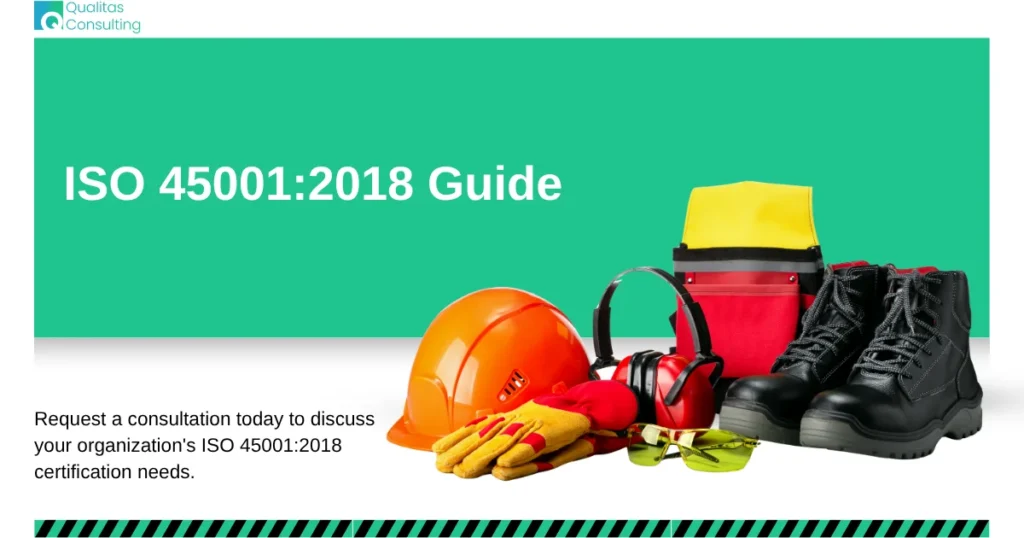
Whether you’re starting ISO 45001 implementation in Qatar or preparing for certification, the Qualitas team can help you understand your requirements and plan the next steps. Request a consultation today to discuss your organization’s ISO 45001:2018 certification needs.
FAQs
What is the ISO 45001:2018 standard?
ISO 45001:2018 is an international standard for an occupational health and safety (OH&S) management system. It helps organizations identify hazards, manage risks, protect workers, and continually improve safety performance.
What are the required documents for ISO 45001:2018?
ISO 45001 requires documented information supporting areas such as the OH&S policy, objectives, risk assessments, legal requirements, audits, management reviews, and corrective actions. The exact documents vary according to an organization’s size, activities, risks, and processes.
What is the ISO 45001 audit checklist?
An ISO 45001 audit checklist typically covers clauses 4–10, including leadership, worker participation, hazard identification, risk controls, emergency preparedness, compliance evaluation, internal audits, and continual improvement. It helps auditors verify whether the OH&S management system meets ISO 45001 requirements.
Is ISO 45001 mandatory?
No. ISO 45001 certification is voluntary under the standard itself. However, customers, contracts, procurement requirements, or specific regulatory expectations may make certification commercially important for some organizations.
How long is ISO 45001 valid?
An accredited ISO 45001 certification normally operates on a three-year certification cycle, with surveillance audits during the cycle and recertification afterward. The certificate remains subject to maintaining conformity with the standard.