
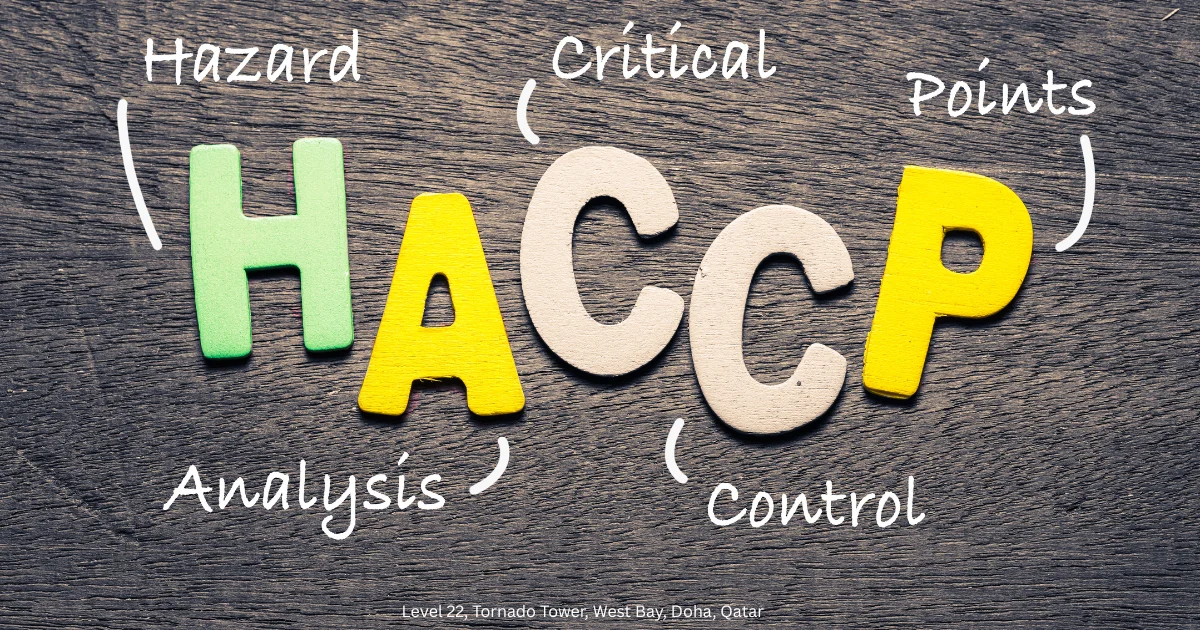
HACCP Certification in Qatar confirms that a food business has implemented a systematic approach to identifying and controlling food safety hazards. The process covers hazard analysis, critical control points, monitoring, corrective actions, verification, and documented procedures.
Qatar’s Ministry of Public Health applies HACCP-based food safety controls within its guidance for food service establishments. The need for effective controls is clear, as WHO estimates that 600 million people become ill from unsafe food each year.
Qualitas Consulting provides ISO and food safety management system consulting in Qatar, helping businesses understand applicable HACCP requirements and prepare for implementation and certification. This guide explains the key requirements, certification process, documents, audits, costs, and timelines for businesses in Qatar.
What Is HACCP Certification in Qatar?
HACCP stands for Hazard Analysis and Critical Control Points. It is a preventive food safety system that identifies biological, chemical, and physical hazards and controls them at critical stages of the food process, from receiving and storage to preparation, cooking, packaging, and service.
A business becomes HACCP certified in Qatar after implementing the required food safety system and completing an assessment by a competent certification body. HACCP certification differs from training: training develops employee knowledge, while certification assesses the business’s implemented food safety system.
Who Needs HACCP Certification in Qatar?
Food businesses face different risks depending on their products, processes, and position in the food chain. HACCP can be especially valuable where several preparation, storage, or distribution stages create opportunities for contamination.
Food Businesses That Commonly Need HACCP
Common examples include:
- Restaurants, cafés, and central kitchens
- Catering companies and event caterers
- Hotels and hospitality businesses
- Food manufacturing and processing units
- Bakeries and confectionery businesses
- Cold stores and food warehouses
- Food importers and distributors
- Businesses involved in food transportation and cold-chain operations
Qatar’s MoPH identifies food handlers, food importers and exporters, restaurants, factories, and their employees among the groups covered by its food safety functions.
When HACCP Certification May Be Required
A business may encounter HACCP requirements through regulatory expectations, customer contracts, supplier approval, tender participation, or export-related requirements. Qatar’s official food establishment registration service lists a food safety certificate such as HACCP among additional documents for certain factories and restaurants.
Food factories also have a particularly important regulatory consideration. A MoPH circular states that food factories must apply a food safety management system based on HACCP as a minimum requirement.
Confirm your HACCP needs with trusted Qatar food safety consultants.
What Are the HACCP Certification Requirements in Qatar?
Strong certification begins with practical controls rather than paperwork alone. Your business needs a functioning food safety system that reflects its actual products, premises, processes, employees, and hazards.
HACCP Team and Food Safety Responsibilities
Start by assigning a competent HACCP team with suitable knowledge of food handling and the business operation. Team members should understand the products, process flow, equipment, hazards, and existing controls.
Management commitment also matters. Staff need clear responsibilities for monitoring, reporting deviations, maintaining records, and implementing corrective actions.
Prerequisite Food Safety Programs
HACCP works best when basic hygiene controls already operate effectively. These prerequisite programs (PRPs) can include:
- Personal hygiene and food handling
- Cleaning and disinfection
- Pest control
- Equipment maintenance
- Supplier approval
- Waste management
- Water and ice safety
- Temperature control
- Storage practices
- Allergen management
Qatar’s food service guidance specifically addresses building and equipment controls, pest control, personnel practices, cleaning and disinfection, operational controls, traceability, recall, and complaint handling.
Hazard Analysis and Critical Control Points
Next, examine every stage of the process flow. Identify biological hazards such as pathogens, chemical hazards such as cleaning residues, physical hazards such as glass or metal, and allergen hazards.
The HACCP team then determines which steps require critical control. FAO and Codex identify seven core HACCP principles, beginning with hazard analysis and determination of CCPs and continuing through critical limits, monitoring, corrective action, verification, and documentation.
Monitoring, Corrective Actions, and Verification
A control only works when employees can demonstrate that it remains effective. CCP monitoring records, temperature records, cleaning records, and other operational records provide evidence that controls are being followed.
When a critical limit is missed, employees need a defined corrective action. Verification then checks whether the system continues to work as intended. Validation provides evidence that selected controls can effectively manage the relevant hazard.

How to Get HACCP Certification in Qatar
A well-planned HACCP certification process in Qatar can be broken into practical stages.
1. Define the HACCP Scope
Identify the products, activities, premises, processes, and food-chain stages covered by the system. A precise scope prevents important operations from being overlooked.
2. Conduct a Gap Assessment
A HACCP gap analysis compares current practices against applicable requirements. It can reveal weaknesses in hygiene, documentation, supplier controls, temperature monitoring, traceability, or process control before the formal audit.
3. Develop and Implement the HACCP Plan
Prepare the HACCP plan, hazard analysis, process flow diagrams, control measures, critical limits, monitoring procedures, and corrective-action procedures. The plan should reflect actual operations rather than generic templates.
4. Train Staff and Maintain Records
Employees should understand their responsibilities and know how to complete relevant records. Training records can help demonstrate competence during audit preparation.
5. Complete the Certification Audit
A certification body assesses the implemented system and supporting evidence. Auditors may review documentation, interview employees, observe operations, and examine records.
6. Address Findings and Receive Certification
If the audit identifies nonconformities, the business must address them within the required process. Once certification requirements are satisfied, the certification body can issue the certificate.
What Documents Are Required for HACCP Certification?
Documentation should make your food safety system easy to understand and verify. Typical HACCP documents include:
| Document or Record | Purpose |
| HACCP manual | Describes the overall food safety system |
| HACCP plan | Defines hazards and control measures |
| Process flow diagrams | Maps each production or preparation stage |
| Hazard analysis | Evaluates significant food safety hazards |
| CCP monitoring records | Shows critical controls remain within limits |
| Corrective action records | Documents responses to deviations |
| Training records | Demonstrates employee competence |
| Supplier control records | Supports approved supplier management |
| Traceability records | Helps track ingredients and finished products |
| Recall records | Demonstrates product recall preparedness |
| Cleaning and pest control records | Supports hygiene controls |
| Temperature records | Demonstrates temperature management |
Qatar’s official food establishment registration guidance also lists risk analysis and process flow diagrams among additional documentation for relevant food establishments.
How Much Does HACCP Certification Cost in Qatar?
The HACCP certification cost in Qatar varies because certification involves more than one expense. Business size, process complexity, number of locations, employee numbers, documentation readiness, audit duration, and consultancy requirements can all affect the final price.
A small food business with an established system may require less preparation than a large manufacturing facility with multiple production lines.
| Cost factor | Why it matters |
| Business size | Larger operations usually require broader assessment |
| Process complexity | More processes can mean greater hazard-analysis work |
| Number of sites | Multiple locations increase audit scope |
| Existing HACCP system | Strong readiness can reduce preparation work |
| Consultancy | Support costs depend on the required scope |
| Certification audit | Fees depend on the certification arrangement and audit scope |
For an accurate HACCP certification price in Qatar, businesses should obtain a scope-based quotation rather than relying on a generic online figure.
How Long Does HACCP Certification Take in Qatar?
The HACCP certification timeline depends mainly on how prepared the business already is. A company with established food safety controls, trained staff, complete records, and effective monitoring can generally move faster than a business starting from scratch.
The implementation timeline may include:
- Initial assessment and gap analysis
- HACCP team formation
- Hazard analysis and documentation
- Implementation of controls
- Staff training
- Internal verification
- Certification audit
- Corrective actions, if required
- Certificate issuance
Qatar’s official food establishment registration service currently lists an estimated delivery time of about 2 days and 30 minutes for that specific government registration service. That should not be confused with the time required to implement and certify a HACCP system.

How Qualitas Consulting Supports HACCP Certification in Qatar
Choosing the right HACCP consultant in Qatar can simplify implementation and improve audit readiness. Qualitas Consulting supports businesses with HACCP requirements, gap assessments, hazard analysis, documentation, prerequisite programs, HACCP plans, and implementation guidance.
Support also covers audit preparation, staff responsibilities, monitoring records, and corrective actions. From Doha and Lusail to Al Wakra, Al Rayyan, Al Khor, and other Qatar locations, structured HACCP certification support helps businesses build practical food safety systems that meet applicable requirements.
What Happens After HACCP Certification?
Certification is not the finish line. Food safety controls must continue working as products, equipment, suppliers, processes, and staff change.
Maintaining HACCP Compliance
Businesses should continue internal verification, monitoring, employee training, supplier review, traceability checks, recall testing, cleaning, pest control, and corrective action. Management should also review the system whenever significant operational changes occur.
Certificate Validity and Recertification
HACCP certification validity depends on the certification arrangement and issuing body. Businesses should check the certificate terms, surveillance requirements, renewal conditions, and applicable scheme rules rather than assuming every HACCP certificate follows the same validity period.
Integrating HACCP With ISO 22000
HACCP can form part of a broader ISO 22000 food safety management system. ISO 22000 integrates HACCP principles with prerequisite programs, system management, and communication across the food chain. ISO states that ISO 22000:2018 remains the current published edition as of 2026, although a new edition is under development.
Conclusion
For Qatar food businesses, HACCP Certification in Qatar provides a structured approach to identifying, controlling, and preventing food safety hazards. Successful implementation requires more than documentation. It depends on effective prerequisite programs, trained staff, hazard analysis, CCP monitoring, reliable records, and ongoing verification.
Whether you run a restaurant, catering company, hotel, bakery, food factory, or distribution business, practical HACCP controls can strengthen compliance, improve audit readiness, protect customers, and build lasting confidence with suppliers and business partners.
FAQs
What are the requirements for HACCP certification?
Requirements generally include prerequisite programs, a trained HACCP team, hazard analysis, CCPs, critical limits, monitoring, corrective actions, verification, and documented procedures and records.
What are the 7 steps to HACCP?
The seven HACCP principles are hazard analysis, CCP identification, critical limits, monitoring, corrective actions, verification, and recordkeeping/documentation.
How much does the HACCP certification exam cost?
There is no single worldwide HACCP certification exam fee. Cost depends on the training provider, qualification level, location, and whether you need training, examination, or business certification.
How long does it take to become HACCP certified?
Training can range from a short course to several days, while business certification takes longer because the HACCP system must be implemented and audited. The timeline depends on the business size, complexity, and readiness.
Does a HACCP certificate expire?
Yes, HACCP certificates can have an expiry or renewal period, depending on the certification scheme and issuing body. Always check the certificate’s terms and ongoing audit requirements.
Can I get a HACCP certificate online?
Yes, you can complete many HACCP training and personal certification courses online. However, online training is different from certifying a company’s implemented HACCP system through an independent certification process.
What are the benefits of HACCP certification?
HACCP helps businesses identify and control food safety hazards, strengthen preventive controls, improve process consistency, support compliance, and build customer confidence.
What are the three main types of HACCP?
HACCP itself isn’t formally divided into three universal types. Different sectors may use HACCP-based systems tailored to food manufacturing, food service, or other parts of the food chain.
What is a HACCP Level 2 certificate?
“HACCP Level 2” usually refers to a food safety or HACCP training qualification, not a universal HACCP certification standard. The exact content and recognition depend on the training or awarding organization.
Is HACCP or ISO better?
Neither is automatically better. HACCP focuses specifically on controlling food safety hazards, while ISO 22000 provides a broader food safety management system that incorporates HACCP principles alongside PRPs, management processes, and communication.